
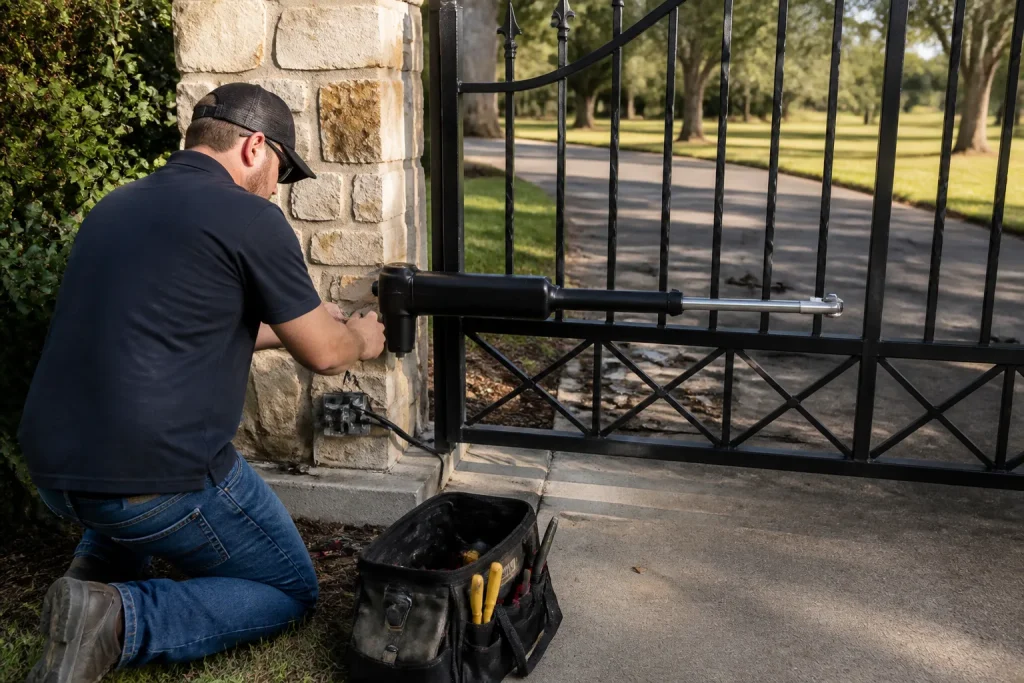
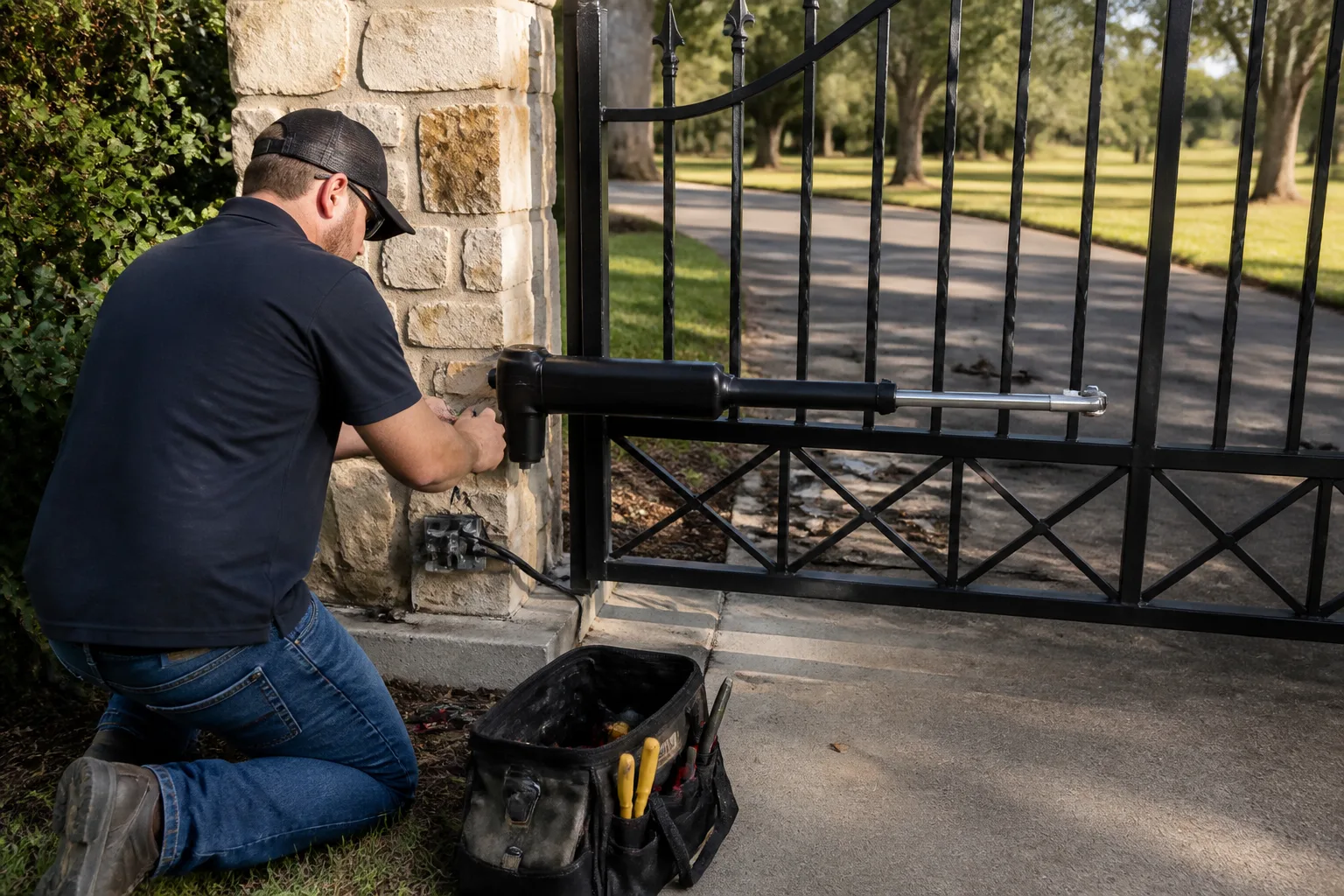
Mighty Mule Gate Repair in Waxahachie: A Homeowner’s Guide
The most common Mighty Mule “motor failure” isn’t a motor failure at all. It’s a $12 battery tender that was never wired correctly at installation, and replacing the actuator won’t fix it. In Waxahachie, where gate openers run hard through Texas heat and clay-heavy soil shifts everything above and below ground, that misdiagnosis sends homeowners back to the parts store twice before anyone asks the right question.
If you’d rather skip the diagnostics and have someone who knows these openers inside out, call (936) 226-3481 for a free estimate.
Key Takeaways:
- Most Mighty Mule “motor failures” are power supply issues, not actuator failures.
- Blink-code diagnostics are readable by any homeowner in under five minutes.
- Waxahachie’s clay soil causes seasonal ground anchor migration that mimics opener failure.
- There’s a clear dollar threshold where repairing a Mighty Mule stops making sense.
- One question separates a real Mighty Mule specialist from a guesser.
What Goes Wrong With Mighty Mule Openers in Waxahachie
Mighty Mule builds openers for the DIY market. That’s not a criticism. The design philosophy is accessibility: pre-wired control boards, color-coded connections, instruction manuals written for a weekend project. But that same simplification creates a specific failure pattern we see across Ellis County. Homeowners install the opener correctly enough to work for a season or two, then small installation compromises begin to surface, one at a time, each looking like a “motor problem” when it isn’t.
We break Mighty Mule failures in Waxahachie into three categories, and they map almost perfectly to the age of the installation. If your opener is under two years old, the problem is almost always installation-related. Between two and five years, it’s wear on specific components. Past five years, you start asking economic questions about repair versus replacement.
Category One: Installation Faults That Bite Later
The first category traces back to day one, when the gate went in. Three installation errors account for the majority of our Mighty Mule service calls in Waxahachie:
- Improper ground stakes. Mighty Mule actuators anchor to a steel ground stake driven into the soil. In Waxahachie’s blackland prairie clay, that stake needs to be set deeper than the manual suggests and, ideally, anchored in concrete. Clay expands and contracts with moisture cycles. A shallow stake slowly works its way loose over two or three seasons, and once it does, the actuator pushes against a moving anchor point. The gate binds. The opener strains. The homeowner hears grinding and assumes the motor is dying.
- Undertorqued limit switch collars. The limit switches that tell the opener where to stop are held by small collars on the actuator shaft. If those collars were hand-tightened instead of properly torqued during installation, they creep. Then the gate starts stopping short or overtraveling. We see this on gates all over Waxahachie, from older homes near downtown to newer builds in Settler’s Glen. The fix takes ten minutes. The misdiagnosis costs a new control board.
- Undersized wire runs. The power source and the opener need wire thick enough for the distance. Many DIY installations use 16-gauge wire when a 12-gauge run is required. The opener works fine initially, then starts faulting as voltage drop degrades the connection over time. If your Mighty Mule blinks a fault code only when the gate is under load, suspect the wire before the motor.
Reading Mighty Mule Blink Codes Before You Call Anyone
Mighty Mule control boards communicate through a blink-code system: a small LED that flashes in patterns, each pattern corresponding to a specific fault. Reading these codes takes under five minutes and tells you whether you’re dealing with a power issue, a limit switch problem, a sensor fault, or a genuine motor failure. The board is typically in the control box mounted near the gate; the LED is visible through a small window or on the board itself. Refer to your model’s manual for the exact location and code chart, since patterns vary between the MM and FM series.
Here’s the part most guides skip: what the codes actually signal versus what they’re commonly mistaken for.
- Rapid flashing (continuous fast blink). Commonly mistaken for a bad board. It’s usually a low battery or a failed battery tender. The opener’s telling you it doesn’t have enough voltage to operate, not that its brain is fried. Test the battery and the charger before condemning the board.
- Two-blink pattern. Commonly mistaken for a motor failure. On most Mighty Mule models, two blinks indicate a stalled or binding gate. The actuator is trying to move but can’t. Check the gate itself: hinges, ground clearance, and whether the anchor stake shifted. The motor may be perfectly fine.
- Three-blink pattern. Commonly mistaken for a wiring fault. Three blinks usually point to the limit switches. That’s the collar issue described above. A three-blink code does not justify replacing the actuator.
- Single blink with slow repetition. Often signals a receiver or remote issue on models that distinguish between control and safety faults. But don’t assume; check your specific model’s chart.
In our experience serving Waxahachie, when a homeowner calls us for Mighty Mule gate repair, the board’s blink code already told us what’s wrong before our truck rolls up. Gate repair in Waxahachie should start with diagnostics, not parts swapping.
Waxahachie’s Clay Soil and the Slow-Moving Ground Stake
Waxahachie sits in the Blackland Prairie, and the soil here is notorious. The clay retains water, expands when wet, shrinks when dry, and moves everything resting in it. Driveway gates feel the effect through their anchor points. A ground stake set in Blackland clay without proper depth or concrete will migrate seasonally. It doesn’t happen in a week. It happens over months: a quarter inch here, a half inch there, until the actuator’s geometry changes enough to bind the gate on its travel path.
The result looks exactly like a failing opener. The operator overloads, the gate stops before fully opening or closing, and the homeowner reports a “dying motor.” But the motor wasn’t the problem. The ground moved.
This is why we habitually check anchor depth and gate plumb on every Mighty Mule service call in Waxahachie, even when the reported symptom is electronic. A healthy opener on a shifted anchor will misbehave all year, and no amount of board replacement fixes it. If your gate was installed by a previous homeowner or a generalist contractor between two other jobs, the anchor is the first thing to check after the blink code.
When Repair Makes Sense, and When Replacement Becomes the Smarter Money
Mighty Mule openers are priced for accessibility. That’s part of their appeal. But that same pricing creates a clear repair-versus-replace threshold that most guides won’t name directly.
The parts worth replacing: batteries, control boards, limit switch collars, remotes, keypads, and receivers. If one of those fails, the repair is typically a fraction of the opener’s replacement cost, and a working Mighty Mule unit can run for years afterward. A battery replacement runs significantly less than the cost of a new actuator. A control board replacement costs more, but still under the price of a complete new kit.
The break point: when the actuator itself has failed. A replacement Mighty Mule actuator is not dramatically cheaper than buying a full new kit, especially once labor is factored. And if the actuator failed because of a binding gate or a shifting anchor, a new actuator will eventually fail the same way unless the underlying mechanical problem is corrected. At that point, Waxahachie homeowners should ask whether a residential-grade DIY unit is the right long-term play, or whether a commercial-grade operator from LiftMaster or FAAC, installed by a gate motor and opener specialist in Waxahachie, makes more sense for a property they plan to keep for another twenty years.
Our rule of thumb: if the actuator is dead and the gate itself is heavy, a solid-iron or steel driveway gate, the honest recommendation is often a commercial-grade opener. Mighty Mule suits lighter gates and budget-conscious installs. We’re happy to tell you which one you have and which direction makes sense.
What a Legitimate Mighty Mule Service Call Should Include
If you call a company for Mighty Mule gate repair in Waxahachie TX, a real specialist visit isn’t a five-minute glance and a quote for a new opener. A proper call covers:
- Blink-code diagnostic read. The technician should read and explain the LED pattern on your control board. If they don’t, ask why.
- Battery, tender, and power supply test. Voltage checks confirm whether power is reaching the opener and whether the battery holds a charge. This is where the $12 tender shows up.
- Gate mechanical inspection. Hinges, plumb, ground clearance, and anchor stake stability. The opener can’t be healthy if the gate isn’t.
- Limit switch verification. Open and close the gate through a full cycle, watching for stopping accuracy and collar tightness.
- Written diagnosis and price before work begins. The diagnosis explains what’s wrong and what fixing it costs, agreed before anything is touched.
The one question to ask any technician before they start: “Have you diagnosed the blink code, and may I see the code reading?” A specialist answers yes and shows you. A guesser deflects toward “needs a new board” or “needs a new motor” without touching the control box. In our experience across Waxahachie, that single question eliminates half the bad service calls before they happen.
The Fault Tree Summary: Working Through It in Order
Here’s the full logic, in the order a genuine diagnostic follows. Use this before calling anyone, or to confirm that the person you hired is doing the job properly.
- Step 1: Read the blink code. Determine whether the board is signaling a power, limit, or motor fault.
- Step 2: Check the power supply. Battery voltage, tender function, and wire integrity solve many “motor failures.”
- Step 3: Check the gate movement manually. Does the gate swing freely without the opener attached? If not, the problem may be hinges, ground clearance, or a shifted anchor.
- Step 4: Check limit collar position. Tighten and realign if the gate stops short or overtravels.
- Step 5: Check the anchor stake. In Waxahachie’s clay, a shifting stake will bind the gate and replicate actuator failure.
- Step 6: Only now consider the actuator or board replacement, after eliminating everything else.
Most Mighty Mule repairs we perform in Waxahachie are fixed in one visit, because the fault tree is followed in order. The homeowners who call us after two or three failed attempts with other outfits are almost always the ones whose technician skipped steps one through three and sold a new actuator that didn’t fix anything.
The Bottom Line
Mighty Mule openers aren’t unreliable. They’re simply installed and serviced by people who skip the diagnostics. In Waxahachie, where soil movement and summer heat add stress no manual mentions, those skipped steps cost homeowners real money. Start with the blink codes. Check power before motor. Respect the anchor. And when considering repair versus replacement, ask whether the unit fits the gate and the long-term plan.
We pulled one Mighty Mule out of a garage over in North Grove last month where the homeowner had already bought a new actuator. The blink code read low voltage. The battery tender had been wired into a switched outlet that was off most of the day, so the battery never charged. He’d spent more on a part he didn’t need than the service call would have cost. We swapped the tender’s connection and tested the existing actuator: it ran perfectly. That’s the difference between parts-swapping and gate repair.
Gate installation in Waxahachie done by a real gate company anchors against exactly these problems from day one. If you’d rather have an expert handle it, Ironworks Gate Co. offers free estimates. Call (936) 226-3481 and we’ll arrive when we say we will.
If you’re in Waxahachie and need Mighty Mule help, whether it’s a blink code you can’t decipher or a gate that’s been binding for months, we’re a phone call away. The call is free. The diagnosis is straight. The price is settled before we touch a bolt.
Frequently Asked Questions
First check the safety sensors, since Mighty Mule openers refuse to close when a sensor is blocked or misaligned. Then read the blink code on the control board, which will tell you whether the issue is power, limits, or a stall condition. A power-cycle reset (disconnecting the battery and charger for 30 seconds) clears many nuisance faults, but if the code returns, the underlying cause hasn’t been fixed. If your Mighty Mule still won’t close after these checks, call (936) 226-3481 and we’ll diagnose it over the phone.
The opener is detecting an obstruction or a sensor fault, or its limit switch collar has shifted. Open-and-not-close is rarely a motor problem: it’s usually a misaligned photo eye, a binding gate that triggers the stall protection on the closing stroke, or a collar that crept out of position. Check the sensors and the gate’s manual swing first. If both are clear, the limit collar is the likely culprit. For a fast diagnosis, call (936) 226-3481.
Basic repairs in Waxahachie, like a battery replacement or limit collar tightening, typically run between $120 and $225 including parts and labor. Control board replacements run higher, often $250 to $450 depending on the model. A full actuator replacement, when it’s actually needed, usually lands between $400 and $600 installed. No legitimate shop will quote a final price without reading the blink code and testing the power supply; watch out for anyone who quotes before diagnosing. For an exact quote, call (936) 226-3481. Estimates are free.
Repair is clearly the better choice for batteries, boards, collars, and remote systems, since those repairs cost a fraction of a new opener. Replacement makes sense when the actuator fails on a heavy gate, or when a shifting Waxahachie anchor keeps killing residential components. At that point, a commercial-grade opener from brands like Elite, LiftMaster, or FAAC is often the smarter long-term investment. We’ll give you a straight answer either way, and an honest recommendation based on your gate’s weight and your long-term plans.
Ironworks Gate Co. serves all of Waxahachie and surrounding areas with Mighty Mule repair, plus gate motor and opener service across nine major brands. One call: (936) 226-3481.
Written by Victor Salinas, Owner at Ironworks Gate Co., serving Waxahachie since 2013.
Need Gate Repair Help?
Call Ironworks Gate Co. - licensed & insured, available 24/7 in Waxahachie.
(936) 226-3481